Race restroom counts run on runner numbers, not guesswork: figure one standard unit per 75 to 100 registered runners at start and finish corrals, plus extras at aid stations. A 5K with 500 runners in Hollywood typically needs 6 to 8 units staged smart, not clustered in one spot.
Start with the field size, then split it between start line, finish line and out-course aid stations. A standard porta potty rental holds a 60 to 70 gallon tank, which covers a few hours of steady race-morning use before it needs a mid-event service. For a full marathon with staggered corrals, most organizers in Hollywood put half the units at the start, keep a third at the finish, and scatter the rest across mile 6, mile 13 and mile 20 aid stations. ANSI/PSAI Z4.3 sets the baseline service interval at once weekly for 10 users over a 40 hour week, but race day compresses thousands of uses into a few hours, so plan extra units rather than extra service visits. OSHA 1926.51(c) governs worker sanitation on the construction side of an event build, not spectators, but it's a useful ratio anchor: one toilet per 20 people is a reasonable starting math for any dense crowd, race staff included. Don't forget the water stations and timing crews working behind the barriers; they need their own nearby unit, not a hike back to the runner corral. If your race also draws a spectator crowd along the route, treat that separately from runner counts and check our event restroom rental guide for crowd-based ratios. Races that finish near Young Circle or run along the beach path should plan restroom clusters at every half mile where crowds bottleneck, since foot traffic backs up fast at narrow points. Pair your restroom order with temporary fence rental at corral entries so lines don't spill into the race lane.
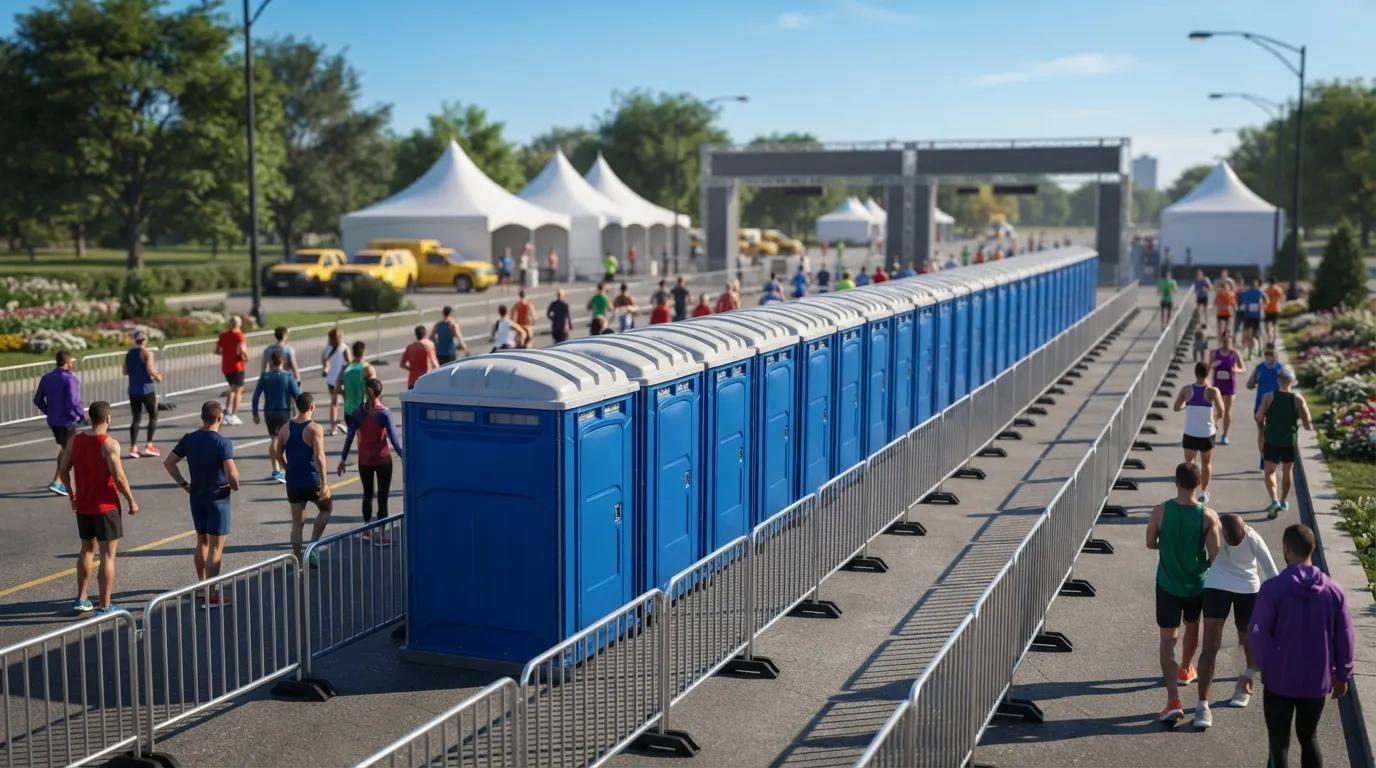
Runners need water and handwashing more than they need anything else, and OSHA 1926.51(a)(1) requires an adequate supply of potable water at any staffed work site, which covers your timing tents and medical stations too. Pair each toilet cluster with a handwashing station rental: 29 CFR 1910.141(d)(2) requires soap and towels or a hand-drying device at wash stations, and hand sanitizer alone doesn't meet that standard. If your finish line has a beer garden or food trucks serving alcohol, a deluxe flushable porta potty near that zone keeps lines shorter and smells down. Timing and medical tents often run on generator power, and if you're staging a temporary power pole for lighting or a results board, brace it the same way every time: set the pole in a stable base, run guy wires at three points spaced evenly around it, and keep the wire path clear of the runner corral and spectator walkway. Loose bracing on a race morning, with wind off the water and thousands of feet moving nearby, is how a pole ends up on the ground; knowing how to brace a temporary power pole properly before the corral fills in matters more than fixing it after the fact. If your event runs past dusk, like a night 5K, add a light tower rental at the finish chute and brace it the same way. Races that expect rain contingency should also look at crowd control barrier rental to keep corral lines orderly if everyone bunches under cover at once.
Yes, and it's not optional once you cluster portable units. ADA Standards section 213.2 requires that at least 5 percent of clustered single-user toilets be accessible, with a minimum of one unit no matter how small the cluster is. An ADA accessible porta potty needs a 60 inch turning circle inside the unit under ADA Standards section 304.3.1, and the path leading to it has to stay clear at 36 inches wide per ADA Standards section 403.5.1. Race organizers in Hollywood often put the ADA unit at the far end of a cluster, which forces a wheelchair racer or spectator to cross the whole line. Put it at the front instead, on a stable, level surface, since ADA Standards section 302.1 calls for firm, slip-resistant ground and beach-adjacent courses tend to have soft or uneven shoulders. Races finishing within a couple miles of the coast should walk the accessible route the week before, not race morning. Runners and spectators coming from Dania Beach, 2.5 miles north, or Hallandale Beach, 7.6 miles southeast, often park outside the closure zone and walk in, so place accessible units near the drop-off point, not buried inside the corral. Check our porta potty placement guide for surface and clearance specifics before delivery day.
Races with a golf tournament tie-in or a fair running alongside can borrow ratios from our golf tournament restrooms and county fair restrooms pages. For cost planning across your whole race weekend, our porta potty rental cost and porta potty rental per day pages break down day, weekend and week pricing so you can budget setup through teardown.
| unit | duration | typical price |
|---|---|---|
| standard | event | $400 |
| ada | weekend | $240 |
| deluxe | week | $250 |
| trailer | event | $3,500 |
Book 4 to 6 weeks out for anything over 500 runners, since Hollywood race weekends compete for the same delivery trucks as construction jobs. Confirm your final count once registration closes, not at the early estimate stage.
Yes, most races schedule delivery the evening before or in the pre-dawn closure window. Coordinate delivery timing with your route marshals so the truck isn't fighting barricade setup at the same intersection.
Placement in the public right of way needs confirming with the City of Hollywood directly; rules vary by route and closure type. Ask early, since race permits often bundle restroom and barricade placement into one approval.
Call for a mid-event service truck; most races with fields over 1,000 runners schedule one anyway. Staging extra units at the start reduces this risk more than scheduling a mid-race pump-out.
For large finish-line festivals, yes, a restroom trailer rental handles heavier traffic with less line buildup. For a straightforward 5K or 10K, standard units spaced well usually cover it at lower cost.
Yes. Hollywood Porta Pros delivers marathon and race restrooms across Hollywood and the surrounding metro, with same-day and next-day drop-off available on most orders.
Pricing depends on the unit and how long you need it. See our cost breakdown and request a free quote for an exact figure.
Standard rentals include scheduled service — a pump-out, a clean, a restock and fresh deodorizer. Busy or hot-weather sites can be serviced more often.
Call now or request a free quote — clean units, on-time delivery, transparent pricing.